

Thatcham Research has launched a comprehensive Electric Vehicle (EV) Blueprint designed to tackle one of the most pressing issues facing the zero-emission transition: the growing number of repairable electric cars being written off following relatively minor collisions.
Unveiled this week, the framework sets out eight key requirements that the automotive sector is being urged to adopt in order to make battery electric vehicles safer to assess, easier to repair and more economically viable to insure.
At the heart of the initiative is a stark reality. High-voltage (HV) batteries can account for up to 40 per cent of a vehicle’s total value. When damage is suspected – even if limited to a casing or mounting bracket – current repair protocols often mandate full battery replacement. For vehicles more than three years old, that can quickly tip the balance towards a total loss determination.
Thatcham argues that such outcomes are not only economically damaging for consumers and insurers, but environmentally counterproductive.
Over the past five years, the industry has made significant strides in EV safety. First responders now follow clearly defined procedures for isolating high-voltage systems at the scene of a collision, while repair centres have invested heavily in technician training and specialist tooling.
As Thatcham notes, the sector has largely moved beyond basic safety familiarisation. The challenge now is operational efficiency: how to recover, assess and repair electric vehicles in a way that makes commercial sense.

A joint survey conducted by Thatcham Research and the Centre for Economics and Business Research (CEBR) underlines the scale of the issue. Battery-related concerns remain the primary worry for 44.6 per cent of insurers and 41.7 per cent of repair professionals.
Dan Harrowell, Principal Engineer, Advanced Technologies at Thatcham Research, said the affordability of EV insurance is directly linked to post-accident repair capability.
“How affordable it is to insure these cars largely relies on how well the industry can handle repairs after accidents,” he explained. “As repair shops have become more experienced with electric vehicle technology, the costs of fixing these cars have already decreased by 10.7%.”
That reduction, referenced to Gecko Risk data, suggests progress is being made. However, Thatcham believes structural design and procedural barriers still risk undermining the long-term viability of the electric transition.
The EV Blueprint outlines eight recommendations intended for adoption by vehicle manufacturers, battery producers, insurers and the repair sector. Collectively, they are designed to reduce total loss rates, improve salvage values and stabilise insurance premiums.
Among the most significant proposals is the introduction of a resettable emergency safety loop. In many current EVs, pyrotechnic devices isolate the battery in a crash but cannot be reset without replacing expensive components. Thatcham argues these systems should mirror the resettable fuel cut-off switches long used in internal combustion vehicles.
The framework also calls for simplified battery handling, eliminating unnecessarily complex removal procedures and subscription-based proprietary tooling that can delay or prevent cost-effective repairs.
Clear and universally accessible vehicle damage assessment guidelines are another cornerstone. The absence of transparent methodologies for evaluating battery integrity after an impact can lead to conservative – and costly – decisions to write vehicles off.
Equally important is the push for accessible diagnostics. Thatcham wants high-voltage system fault-finding to be standardised and compatible with widely available equipment, in the same way On-Board Diagnostics (OBD) systems transformed ICE vehicle servicing.
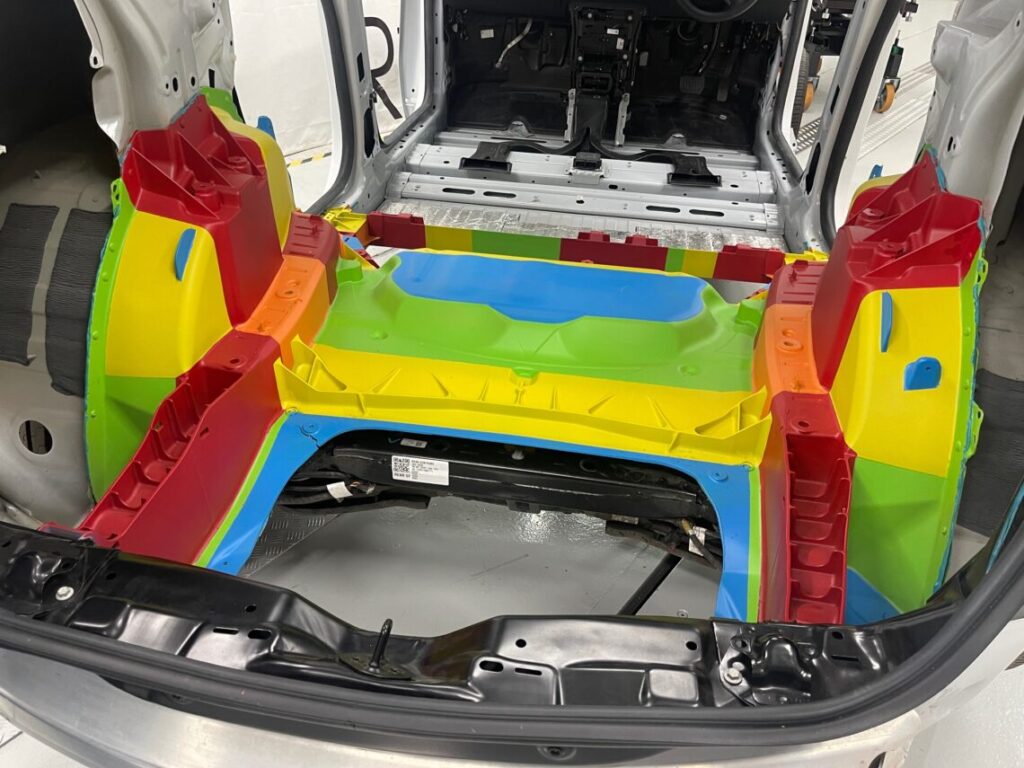
Design-led changes are also proposed. These include more robust underbody shielding to protect battery packs from kerb strikes and debris, as well as replaceable protective components priced at realistic levels.
The blueprint further recommends the development of established HV battery repair strategies, allowing casing or bracket repairs without complete pack removal, and promoting resettable or easily replaceable pyrotechnic fuses.
Looking longer term, Thatcham is advocating serviceable battery construction, favouring modular designs with removable fasteners rather than permanent adhesives. This would enable refurbishment and remanufacture within the UK, supporting a domestic circular economy.
Finally, the organisation urges improved HV system component design, including the repositioning of vulnerable charge ports and the use of standalone modules to reduce repair complexity.
Underpinning the eight recommendations are three foundational principles: safety, sustainability and affordability.
Safety remains paramount, encompassing everyone from roadside recovery operators to bodyshop technicians. Sustainability centres on enabling a genuine circular economy for high-voltage batteries, extending usable life through repair and refurbishment rather than replacement. Affordability focuses on total loss avoidance and the availability of new, refurbished or remanufactured parts at reasonable cost.
The blueprint presents a representative case study: a three-year-old EV suffering minor side impact damage to a battery mounting bracket. Under current mandated procedures, damage to the battery casing may necessitate full replacement with a new unit costing more than the car’s market value, resulting in write-off.
In Thatcham’s proposed future state, the casing would be repaired in situ or replaced with a lower-cost refurbished unit, returning the vehicle to service quickly and preserving residual value.
Data cited within the blueprint reinforces the argument that EV batteries are not inherently short-lived consumables. Testing of more than 8,000 electric cars and light commercial vehicles by specialist firm Generational found that eight- to nine-year-old vehicles retained a median 85 per cent of original battery capacity. For four- to five-year-old EVs, median state of health stood at 93.53 per cent.
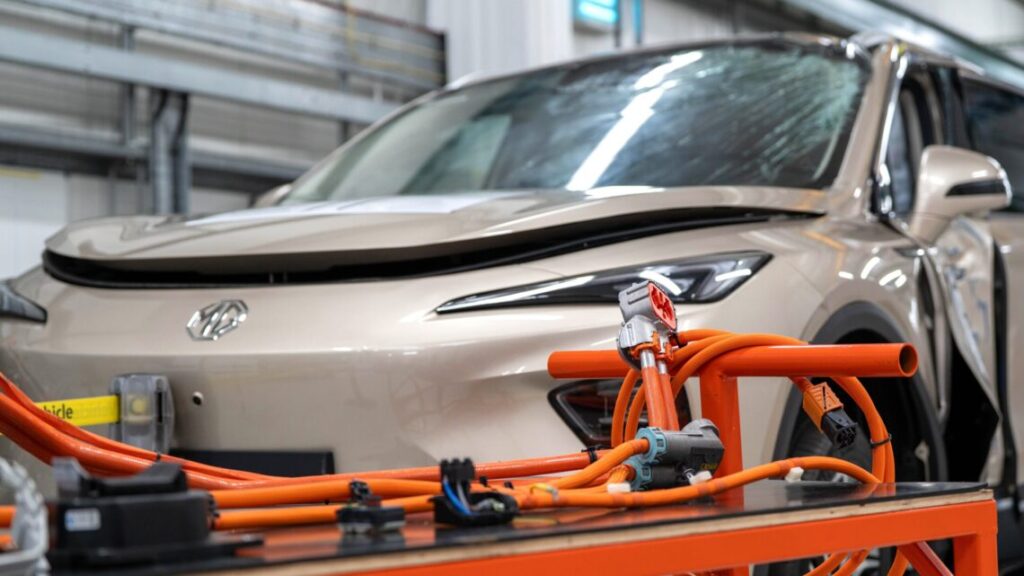
For Harrowell, such figures strengthen the case for maximising in-service life. “Real-world data is showing that batteries can have a very long usable life that we should try to maximise through sustainable repair,” he said.
Replacing an entire pack because of localised structural damage, he argues, undermines both the environmental and financial rationale for electrification.
At a macro level, the blueprint addresses two interlinked challenges: post-collision diagnosis and post-collision repair execution. By standardising and improving both, Thatcham believes total loss rates can be reduced, with knock-on benefits for salvage performance and residual values.
Lower write-off rates would, in theory, feed through to more stable insurance premium structures – a critical factor as EV adoption accelerates and private buyers scrutinise running costs more closely.
Jonathan Hewett, Chief Executive of Thatcham Research, framed the issue in strategic terms. “The transition to electric vehicles represents one of the most significant transformations our industry has ever undertaken, but it cannot succeed if EVs become economically unviable to insure and repair,” he said. He warned that writing off repairable vehicles due to design limitations risks damaging consumer confidence and diluting the sustainability credentials of electric mobility.
Hewett stressed that the recommendations are grounded in more than a decade of in-house EV impact assessment and repair experience. Resettable safety systems, accessible diagnostics and serviceable components are already commonplace in conventional vehicles, he noted; there is no inherent technical barrier preventing similar standards in EVs.
The EV Blueprint is explicitly collaborative in tone. Thatcham is calling on vehicle and battery manufacturers, insurers, repairers and training providers to align around shared best practice.
Such alignment, the organisation argues, is essential to ensure that the UK’s electrification pathway remains not only environmentally sound but economically sustainable for the millions of motorists expected to switch to battery power over the coming decade.
Thatcham Research, which assesses every car and light commercial vehicle on UK roads through its Vehicle Risk Rating model, positions the blueprint as an extension of its core remit: reducing risk and improving clarity in modern motoring.
For the EV sector, the message is clear. The technical capability to repair and refurbish high-voltage systems exists. The challenge now is embedding those capabilities into vehicle design and industry practice from the outset.
If adopted widely, Thatcham’s eight-point plan could mark a pivotal shift away from precautionary write-offs towards a repair-first culture – one that protects residual values, reins in insurance costs and delivers on the long-promised sustainability case for electric vehicles.